

Triyo Lab (formerly Qualiscope Formation) is a non-profit organization that acts as a trusted third party in the evaluation of professional training programs. Its mission is to help learners, companies, and training providers better measure the impact of training on skills development through independent tools and reliable assessments.
From December 2025 to May 2026, I joined its product team, composed of around ten UX/UI designers, Product Owners, and developers. I contributed to the design of two platforms: SKILLS, a public platform allowing learners and third parties to rate and evaluate the training programs they have completed, and SKILLS PRO, an MVP designed for executives and HR managers to monitor and manage their training initiatives.
My Role
UX/UI Designer within the Product Team, UX Researcher
Tools Used
Figma, FigJam, Jira, Confluence, Canva, Google Workspace, Typeform
Timeline
December 2025 – May 2026
Duration
6 months
My Role
UX/UI Designer within the Product Team, UX Researcher
Tools Used
Figma, FigJam, Jira, Confluence, Canva, Google Workspace, Typeform
Timeline
December 2025 – May 2026
Duration
6 months
Text displayed on the image: “Independence serving skills development.”
Existing product audit: understanding the limitations of V1
Before contributing to the SKILLS redesign, my first responsibility was to conduct a comprehensive audit of the existing platform. I analyzed all user journeys, both for learners and third-party evaluators, in order to identify the main usability issues and experience barriers.
This analysis revealed several areas for improvement: interface inconsistencies (different icon families, duplicated components), unclear terminology, insufficiently explicit error messages, and an information hierarchy that needed refinement.
Each issue was documented, accompanied by a UX/UI recommendation, and prioritized according to its nature. Development-related issues were transformed into Jira tickets, while design improvements were directly integrated into Figma mockups to deliver Ready for Development interfaces to the development team.
UX/UI Design: creating clearer and more accessible user journeys
Throughout my mission, I contributed to the design of several features across the SKILLS and SKILLS PRO platforms, working closely with designers, the Product Owner, and developers.
SKILLS PRO
My first assignment was to contribute to the design of the SKILLS PRO MVP, a tool designed for decision-makers and HR managers to measure the impact of completed training programs and support their decision-making process.
I contributed to defining the visual direction, creating the first interface components, and designing several key product screens. The mockups served as a collaborative workspace between UX, product, and development teams to validate user flows and functional decisions before implementation.
SKILLS
For the public SKILLS platform, I was responsible for redesigning the four evaluation campaign journeys (work-study programs and continuing education, from both learner and third-party perspectives).
My work focused on simplifying user flows, clarifying questions, improving information hierarchy, and making the experience more intuitive and accessible. The objective was to reduce misunderstandings while ensuring consistency between interfaces and the product’s design system.
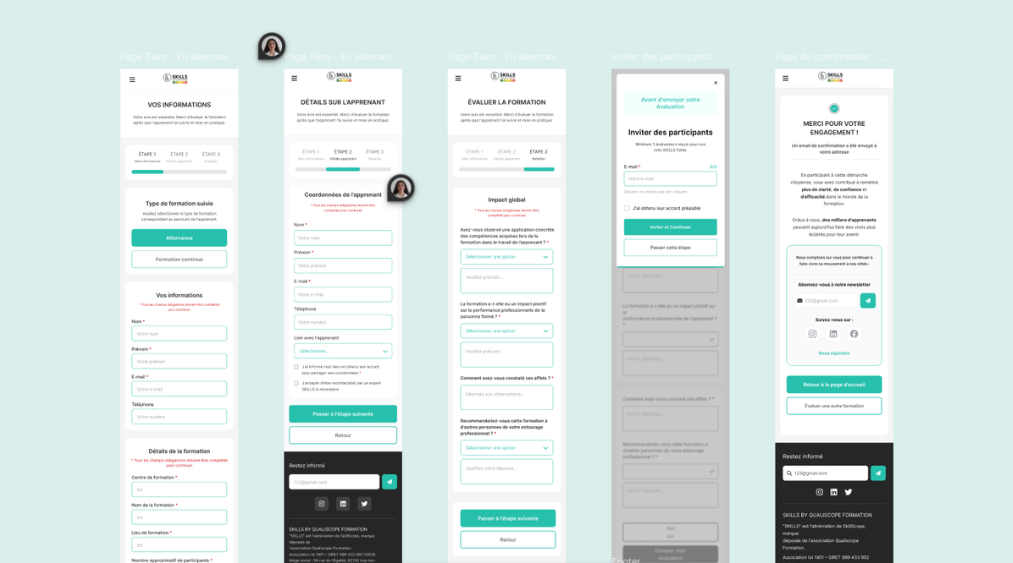
Mockups of part of the evaluation campaign journeys.
Before handing over the designs to developers, I organized several user tests with volunteers to validate the designed journeys. The feedback collected helped identify the remaining friction points, which were then integrated into the mockups or converted into Jira tickets depending on their nature.
In parallel, I contributed to designing the new “Training Programs” pages by defining the user flow and structuring the user experience before moving into the UI design phase.
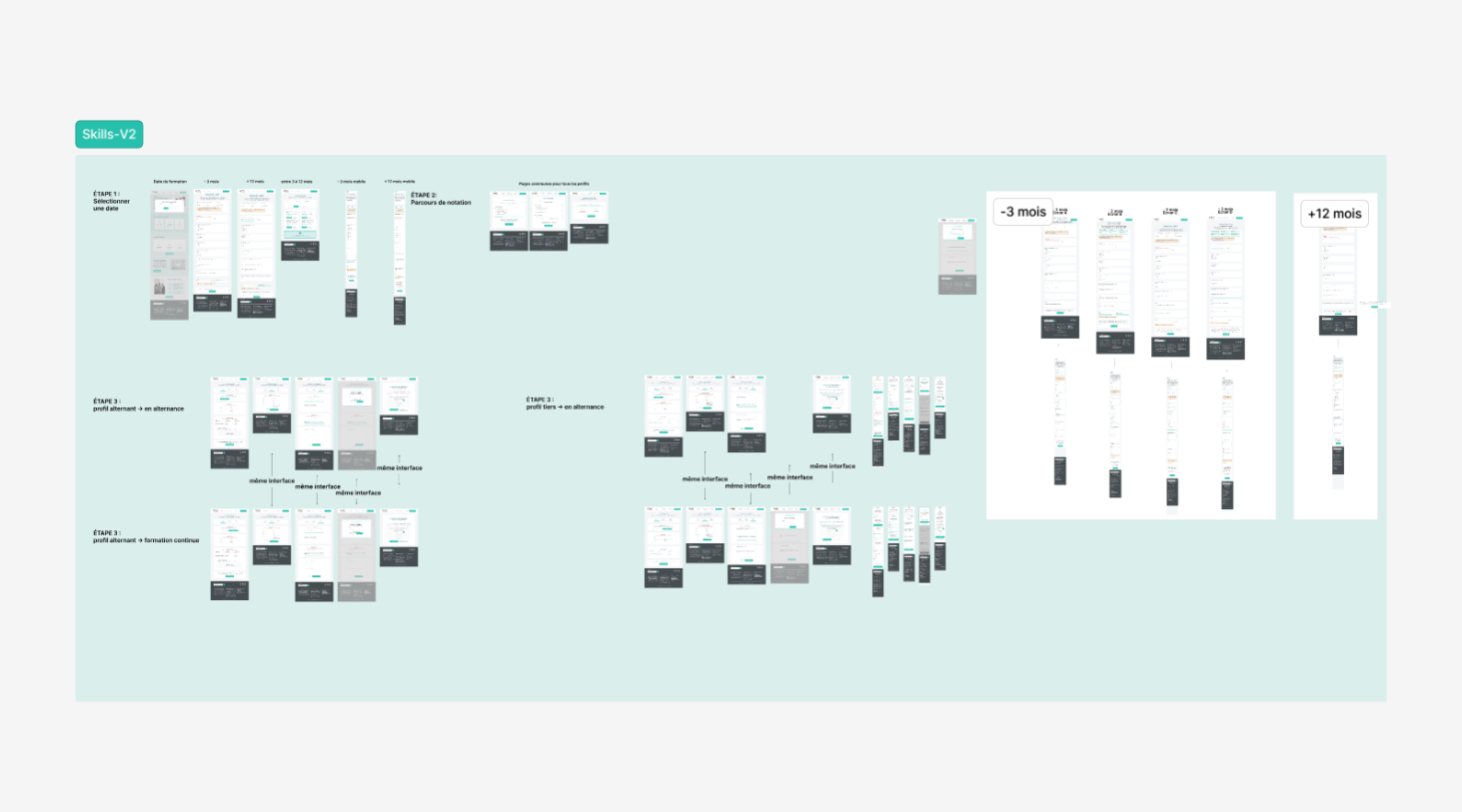
Overview of the 4 evaluation campaign journeys.
User Research: evolving the product based on user needs
Alongside the design work, I contributed to the user research process conducted as part of the SKILLS redesign. The objective was to better understand user’s real needs and support future product decisions with insights gathered from field research.
I helped prepare the studies by contributing to the research plan, interview guides, and questionnaires. I then conducted several qualitative interviews, independently or alongside another researcher, with learners and third-party evaluators to identify their expectations, pain points, and usage habits.
The insights gathered from these interviews were centralized and analyzed collaboratively in order to identify key user behaviors and formulate initial design hypotheses for the V2.
I also contributed to the creation and final review of a quantitative questionnaire designed to validate or challenge these hypotheses. Its purpose was to complement qualitative findings, reduce potential biases linked to the initial participant sample, and quantify observed trends in order to guide product decisions.
Once the results were analyzed, I worked alongside a UX Researcher to create the first SKILLS personas. By combining qualitative and quantitative data, we defined representative user profiles to support the design of future V2 user journeys.
Designing the Expert and Expert Coordinator Spaces
I then contributed to the design of two secure back-office areas of the SKILLS platform: the Expert Space and the Expert Coordinator Space.
Based on business requirements and UX specifications, which I helped define, I designed both desktop and mobile interfaces following a mobile-first approach.
The Expert Space enables evaluators to manage their scoring assignments, track their activity history, submit their assessments, and access the results of the training programs they have evaluated.
The Expert Coordinator Space is dedicated to the operational management of the expert network. I designed several interfaces to streamline availability tracking, profile management, recruitment, and assignment monitoring.
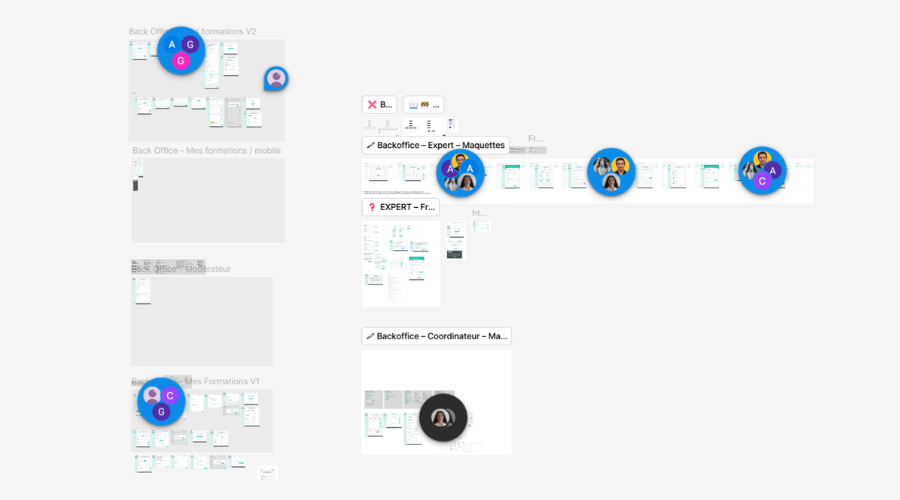
Overview of the Expert Space designed in Figma.
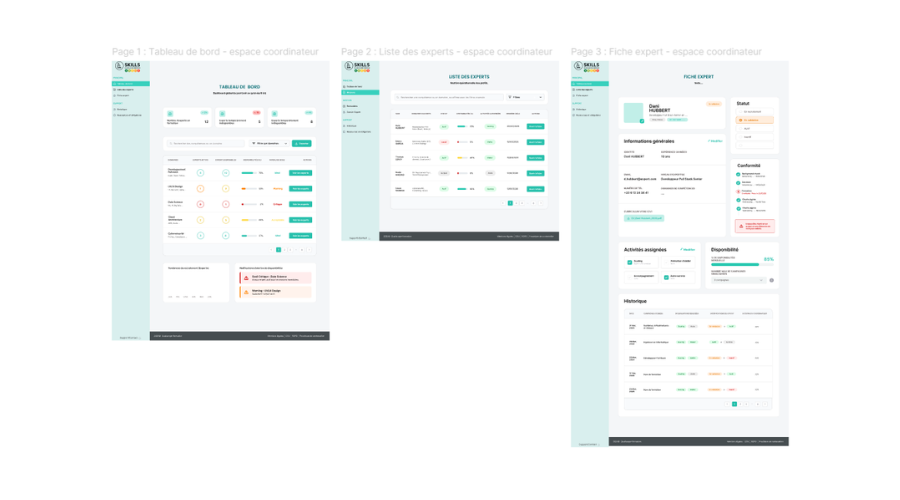
Selection of screens from the Expert Coordinator Space.
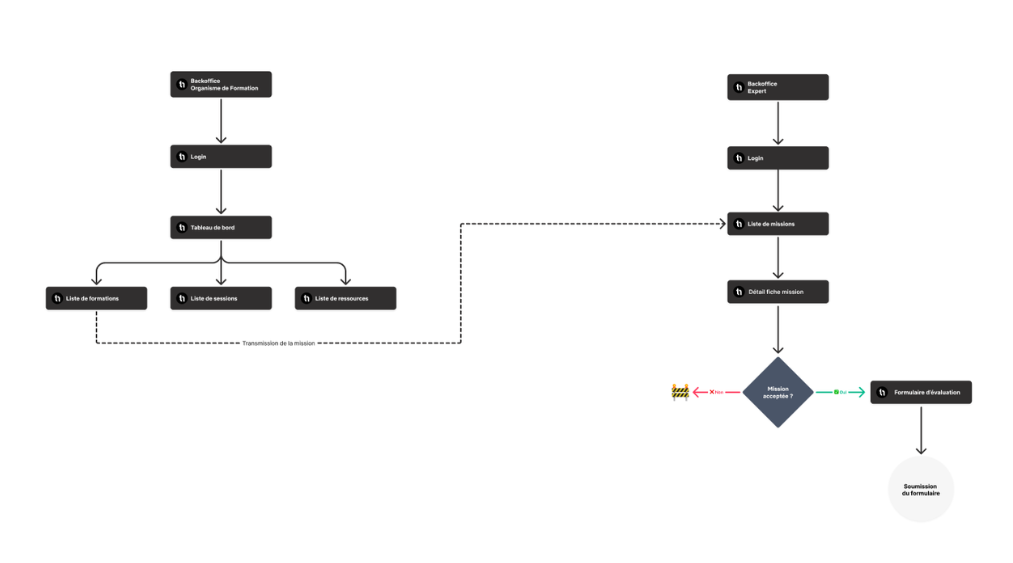
Back-office user flow architecture (Training Provider and Expert): from authentication to assignment completion.
Product Collaboration & Continuous Improvement
Throughout the project, I worked closely with designers, developers, and the Product Owner to ensure consistency across user journeys and support the continuous evolution of the platform’s different services.
Beyond designing interfaces, I contributed to bug tracking, Jira ticket creation, and the preparation of Ready for Development mockups for the development team. I also responded to high-priority product requests by rapidly designing new interfaces whenever project needs required it.
As the UX/UI team grew from 3 to eight 8, I regularly presented my work, shared research findings, and defended my design decisions during product reviews. These collaborations allowed me to develop a broader product vision while working closely with specialists from different disciplines.