

Dear You is a virtual postcard platform born from a reflection on today’s digital interactions, which are often fast and superficial, with the intention of offering a more personal and sincere experience.
It allows users to send messages, thoughts, and personalized attentions to their loved ones within a space designed to encourage emotional expression. The experience is built around a clean and intentionally minimal interface, designed to reduce cognitive load and leave full space for the act of writing. This approach continues to evolve through user feedback and product iterations.
Since its launch, more than 150,000 cards have been sent by users across hundreds of countries.
Dear You was imagined, designed, and built solo, from strategic thinking to product launch: user research, information architecture, wireframing, prototyping, visual identity, and development using no-code tools and generative AI.
Each product iteration is guided by a continuous improvement approach, informed both by user feedback and usage data.
Dear You is also a personal exploration space: where design serves emotion, and technology is used to strengthen human connection.
My role
Product Designer, UX/UI Designer, Founder
Tools Used
Figma, v0, Vercel, Claude, Antigravity, GitHub, Supabase, Cloudflare, Scaleway, Umami, Tally…
Timeline
March 2026 (Ongoing project)
My role
Product Designer, UX/UI Designer, Founder
Tools used
Figma, v0, Vercel, Claude, Antigravity, GitHub, Supabase, Cloudflare, Scaleway, Umami, Tally…
Timeline
March 2026 (Ongoing project)

The starting point
This project started with a letter I sent to a friend in the Netherlands, which never reached her. A message written with care, that got lost along the way.
This moment highlighted something broader: the difficulty of expressing real intention through today’s digital communication formats. A DM is sent instantly. An email feels formal and work-like. Something was missing in between, a space to say things differently, with more care and presence.
The desire to bring back the poetry of a postcard. That simple gesture of writing to someone who matters, choosing an image, taking time to express something real, and knowing it will reach them.
Problem & solution
Today’s digital communication is fast and transactional. Messages flow through standardized formats: DMs, emails, instant messaging, where the intention behind the message is often lost in favor of speed.
I wanted to build an alternative format that does not optimize for speed, but instead reintroduces intention into the act of writing to someone.
Dear You is a virtual postcard platform sent through a unique link. Users create a card by writing a message, adding an image or drawing, and flipping it like a real postcard before sending it.
The recipient receives a digital letter that opens like real mail.
The goal is not to replace traditional messaging, but to offer a different type of exchange: slower in gesture, more intentional in writing, designed both for the sender, with a simple and fluid experience, and for the receiver.
March 2026 : Building, experimenting and launching an MVP
Before writing a single line of code, I tested several AI tools using the same prompt and the same design mockup to identify which ones truly understood the product I wanted to build. Only v0, Claude, and Antigravity met my expectations.
I then structured the product design process: user research, writing a PRD, designing wireframes and user flows in Figma, testing visual identity directions, analyzing competitors, and iterating with early beta users.
Dear You went live on March 18th, 2026.
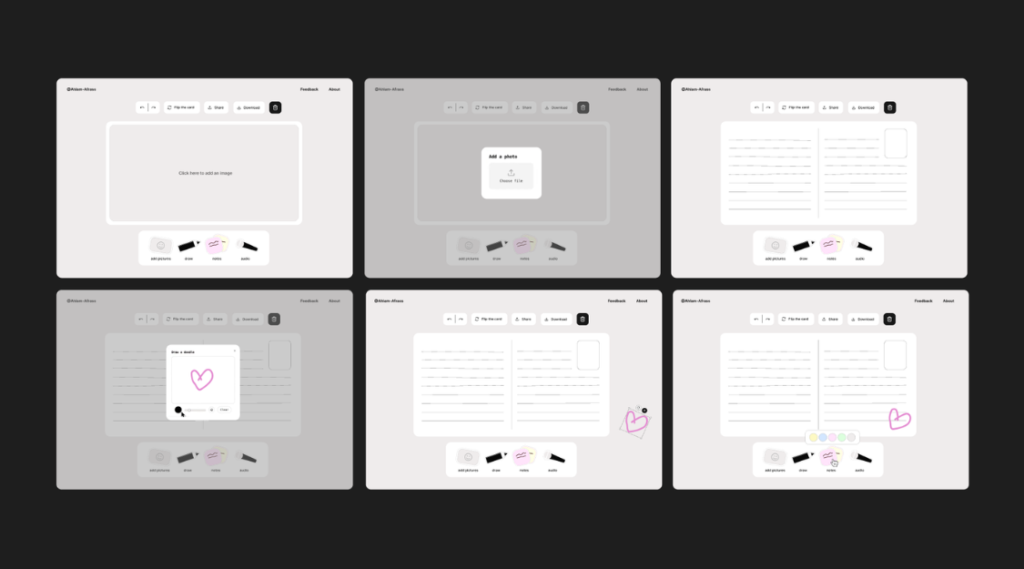
Early Figma mockups defining the postcard creation flow, designed to be intentionally simple and focused on writing. These screens served as the foundation for building the first functional MVP using different AI tools (v0, Claude, Antigravity, etc.).
April 2026 : Validating the product with early users
15 days after launch (total): 240 visits, 60 cards sent.
1 month after launch (total): 7,700 visitors, 2,500 cards sent.
This month, I purchased the domain dear-you.cards.
At the same time, I joined a Weekly Builder Meeting on Zoom, bringing together around ten builders from the United States, Canada, South Korea, Sweden, India, and Russia. Very different profiles, inspiring projects, and a shared space to push each other forward.
I continued refining the product through user interviews, surveys, and A/B testing. On the design side, I worked on the visual identity, improved the interface, and designed the animation of the letter opening upon reception.
To reach early users, I started commenting on Instagram posts related to similar products or competitors, engaging with users and introducing Dear You when relevant. One concrete example: a user complained that a tool didn’t work on mobile. I replied that dear-you.cards was fully responsive. Result: +500 visitors. Slow, but effective.
The top 5 countries at this stage were: India, Philippines, Indonesia, United States, and France. People I don’t know, in countries I didn’t initially target, choosing to write something to someone who matters to them.
By the end of the month, we hit the first infrastructure limits: Supabase storage reached its free-tier cap of 1GB. I started exploring ways to scale without degrading the experience.

Exploration of Dear You’s visual identity. Several logo directions were tested in Figma to find a system aligned with the product intention: a simple, personal service centered around the act of writing.
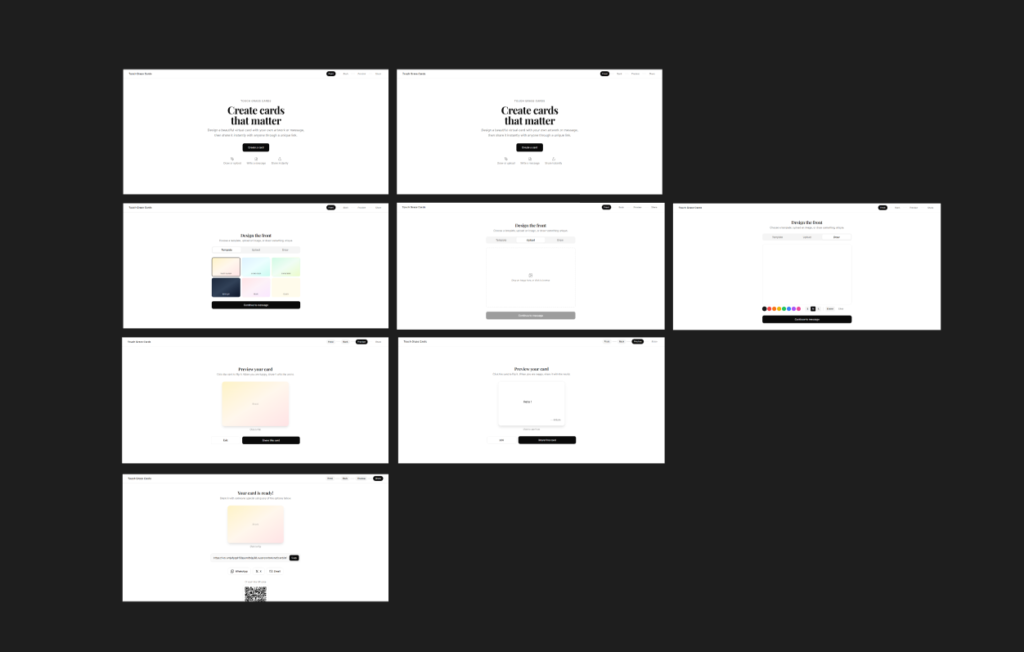
Second iteration of the product wireframes. The creation flow was redesigned based on early user feedback. This version reworked the entire experience, from landing page to card sending flow, to simplify navigation and improve clarity across steps.
May 2026 : Scaling through unexpected growth
What I didn’t anticipate: Dear You started being shared organically on Instagram, TikTok, and Pinterest. Traffic grew rapidly, and the first technical challenges appeared.
At first, I was simply commenting on posts where I could reach my target audience: “Cute websites you must try”, “Wholesome websites to check out instead of doomscrolling”, “Websites that keep my sanity intact”… and something started to work.
The top 5 countries using Dear You became: India, Indonesia, Philippines, United States, and Pakistan. France was no longer in the top 10.
With this growth, the entire infrastructure had to evolve. On May 18, Supabase reached 6GB of storage while the free tier only includes 1GB. Vercel also started hitting its limits. The architecture had to be rethought in real time, without interrupting the service.
Server migration: Dear You was initially hosted on Vercel, a US-based platform that becomes paid at scale. The system was migrated to a Hetzner VPS, providing fixed cost and full control.
Image storage: Assets were moved from Supabase to Scaleway, a French provider offering better cost efficiency and control. Images are now automatically converted to WebP, reducing file size and load time.
Analytics: We deployed Umami as a self-hosted analytics solution directly on the server, an open-source alternative to Google Analytics with no third-party dependency.
Global performance: Cloudflare was added in front of the system to serve Dear You from edge locations closer to users, especially important for South and Southeast Asia, which represents a significant share of traffic.
Supabase: We kept Supabase but migrated it to a self-hosted open-source setup to regain full control over data.
During the 20-minute migration window, instead of a standard error page, we displayed a maintenance page with a feedback survey link.
30 responses in 20 minutes, unexpectedly high engagement.
As of May 31, 2026: 87,500 visitors and 28,500 cards sent.
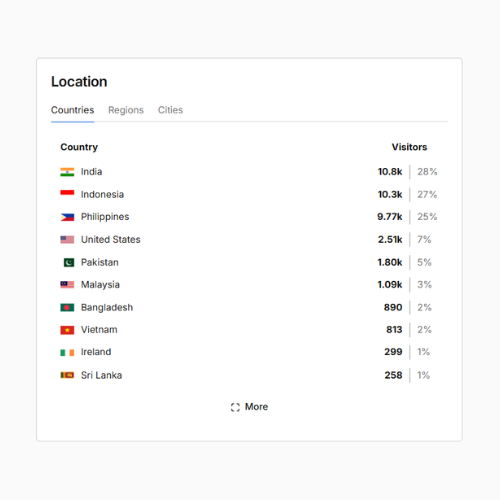
The ten main countries using Dear You. (May 2026)
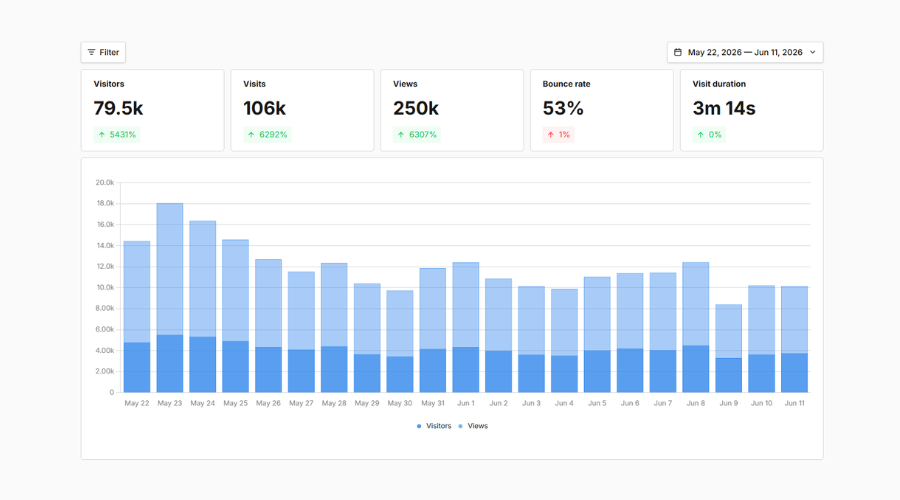
Évolution du trafic sur le mois de mai 2026. Les données Umami permettent de suivre la croissance du projet et de mesurer l’impact des partages organiques sur les réseaux sociaux. (May 2026)
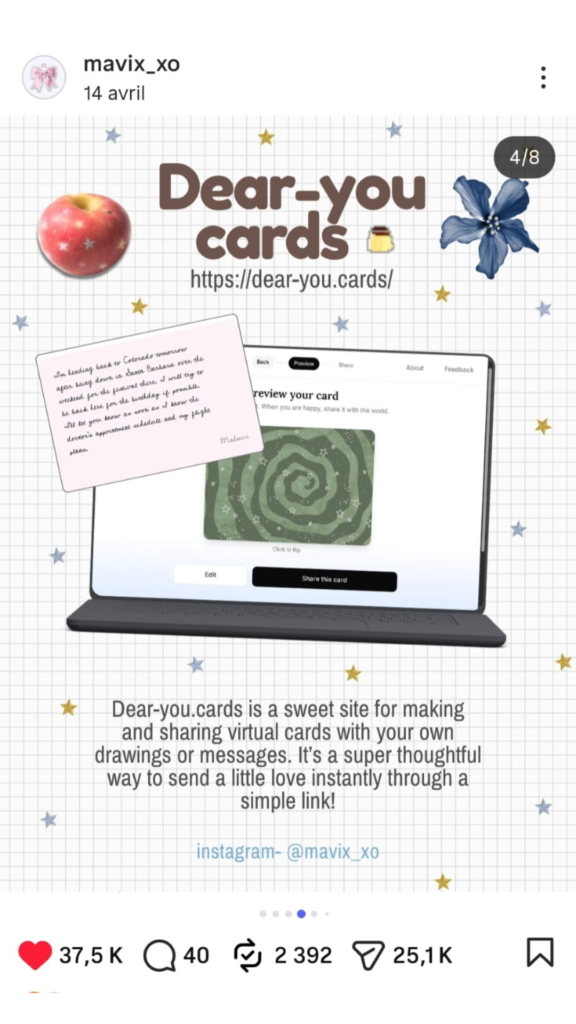
Posts of @mavix_xo shared on Instagram and Pinterest introducing Dear You to their community.
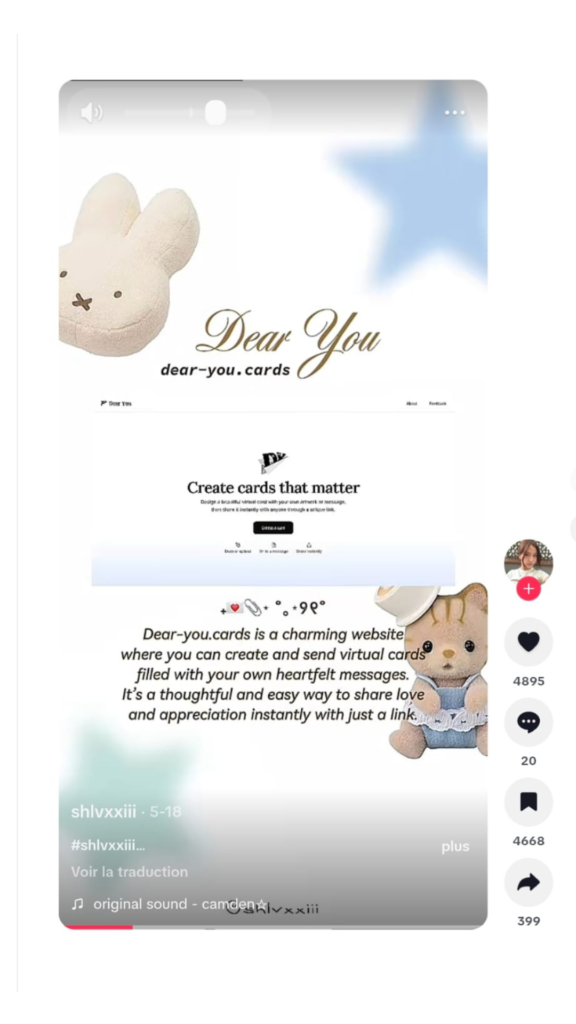
A TikTok video made by @shlvxxiii, surpassing 140,000 views, becoming one of the main traffic drivers and marking the start of significant organic growth.
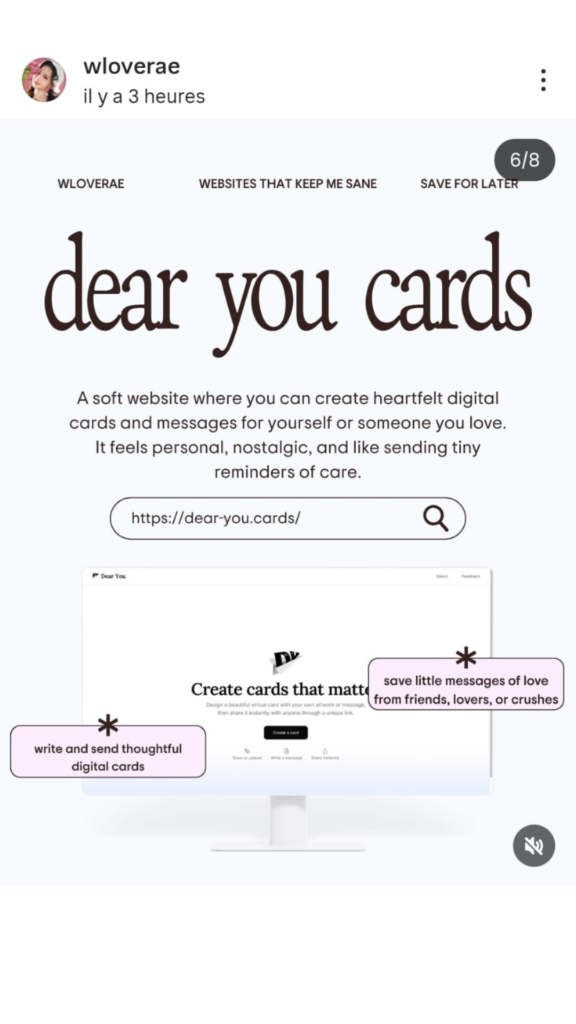
An Instagram post made by @wloverae showcasing Dear You to their audience and contributing to product visibility.
June 2026 : Evolving the product through user data
During this period, Dear You continued to evolve both in terms of user experience and product development.
The visual identity was refined with a new art direction: logo, homepage, color palette, content, and navigation.
New features were shipped: account creation, card history, authentication, an admin back-office, and an expanded content library (templates, backgrounds, stickers, and stamps).
The infrastructure was further optimized with automatic image conversion to WebP, separation of development and production environments, and updates to compliance-related aspects.
To inform upcoming product decisions, a survey was published directly within Dear You. Over 3–4 days, it gathered more than 450 responses, providing valuable insights into user behavior, expectations, and most requested features.
These learnings marked the beginning of a new phase for the project: exploring monetization and redesigning the card creation flow.
As of June 18th, 2026, Dear You reached 150,000 visitors and 48,500 cards sent.
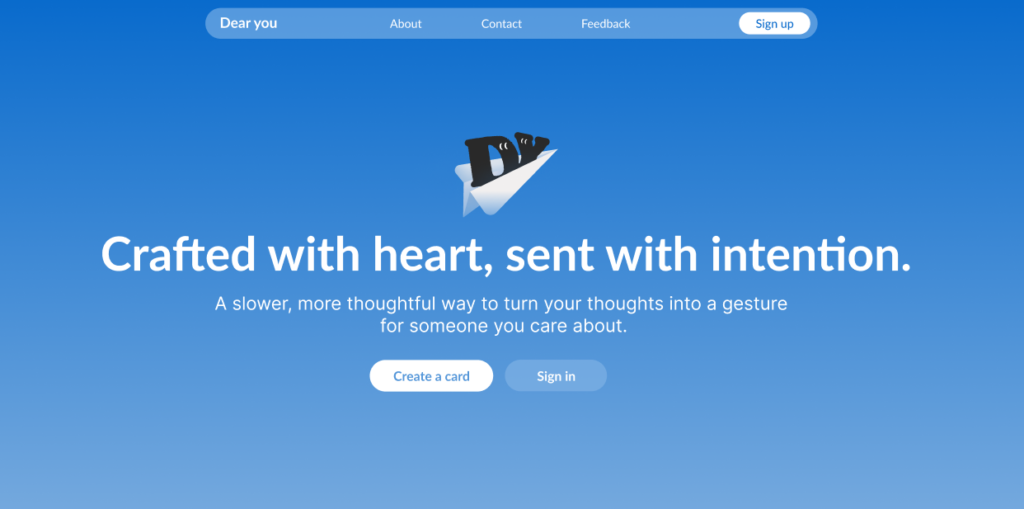
New art direction for Dear You. This redesign introduces a new logo, a refreshed color palette, a reworked content hierarchy, and a simplified navigation designed to better guide users from the moment they arrive on the platform.